
PP 20/2026: Which New Companies Can Still Use the 0.5% Final Income Tax?


A founder and finance lead planning tax for a newly established company.
On 22 April 2026, the government enacted and promulgated Government Regulation No. 20 of 2026 (PP 20/2026), an amendment to PP 55/2022 on adjustments to income tax rules. One of its changes is who may still use the 0.5% final income tax on revenue.
For business owners who have just set up a company, that news can easily cause alarm. Illustrative example: you recently incorporated a PT and budgeted tax at 0.5% of revenue, then read that "new PTs can no longer use the final rate". Does your tax now jump to 22%? Are CVs and single-founder companies in the same boat? Those are fair questions, and the answer is more nuanced than the headline.
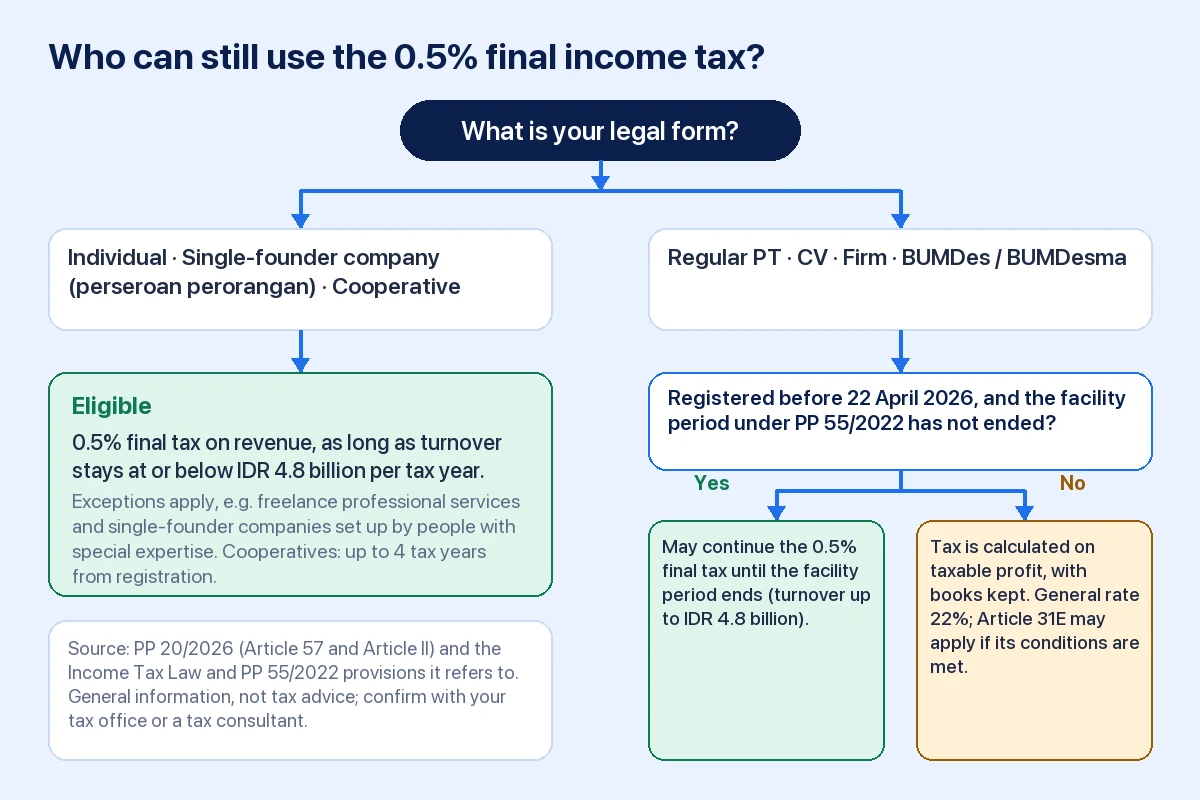
The short answer: Government Regulation No. 20 of 2026 (PP 20/2026) does not raise company tax to 22% of revenue; what it changes is who may still use the 0.5% final income tax on revenue. Since 22 April 2026, that facility is limited to individuals, single-founder companies (perseroan perorangan), and cooperatives. Regular PTs, CVs, firms, and village-owned enterprises (BUMDes) that register now fall under the general profit-based regime and must keep books, while those already registered have a transition period.
Monit Insight:
- What is restricted is which legal entities may use the 0.5% final tax, not the 0.5% rate itself.
- A PT or CV registered before 22 April 2026 can keep using it until the remainder of its facility period ends; one registered afterwards cannot.
- Profit-based tax needs clean books from the first month, not at year end.
Note: this article is general information based on the text of PP 20/2026 and the Income Tax Law and PP 55/2022 provisions it refers to, not tax advice. Every company's situation differs; confirm with your tax office (KPP) or a tax consultant before deciding.
What Does PP 20/2026 Actually Change?
PP 20/2026 amends PP 55/2022 on adjustments to income tax rules. It was enacted and promulgated on 22 April 2026 and took effect on the date of promulgation.
The final income tax rate on business income remains 0.5% of gross turnover, with a turnover cap of IDR 4.8 billion per tax year. Turnover is counted across all business and freelance-professional income, final and non-final, including income earned abroad (Article 58(1)). What changed is the list of eligible taxpayers:
- Article 57(1) now names only individual taxpayers, single-founder companies (perseroan perorangan), and cooperatives.
- Regular PTs, CVs, firms, and BUMDes/BUMDesma are no longer listed as eligible.
- The time limit on using the facility in Article 59 of PP 55/2022 has been deleted. For cooperatives, a limit of 4 tax years from registration is now written directly into Article 57(2)(f).
The general explanation to the regulation makes two points: in principle, individuals running a business and corporate taxpayers must keep books, and the simplified final rate is meant for individuals and single-founder companies. It also notes that some taxpayers had been using the final rate to avoid tax.
Who Can Still Use the 0.5% Final Tax?
| Entity type | Still eligible for 0.5%? | Notes |
|---|---|---|
| Individual | Yes | Turnover up to IDR 4.8 billion per tax year. Income from freelance professional services (doctors, lawyers, consultants, influencers, and similar) is excluded from this final rate. |
| Single-founder company (perseroan perorangan) | Yes | Turnover up to IDR 4.8 billion per tax year. Exceptions apply, see the next section. |
| Cooperative | Yes, limited | For up to 4 tax years from the tax year of registration (the registration year counts as year one), with turnover up to IDR 4.8 billion. |
| Regular PT (not a single-founder company) | Not for those registered after 22 April 2026 | Those already registered may continue for the remainder of their facility period, if it has not ended. |
| CV and firm | Not for those registered after 22 April 2026 | Those already registered may continue for the remainder of their facility period, if it has not ended. |
| BUMDes / BUMDesma | Not for those registered after 22 April 2026 | Those already registered may continue for the remainder of their facility period, if it has not ended. |
So the answer to "can a new company still use 0.5%?" depends on its legal form. A single-founder company can; a regular PT or CV cannot.
When Can a Single-Founder Company Not Use 0.5%?
A single-founder company is not automatically safe. Article 57(2) excludes it, among other cases, when:
- It was set up by an individual with special expertise who provides services similar to freelance professional services. In other words, a single-founder company cannot be used to turn professional income into business income.
- The individual's turnover together with all single-founder companies that person set up exceeds IDR 4.8 billion in a tax year. For spouses who have a written property separation agreement, or where the wife elects to exercise her own tax rights and obligations, the turnover of the husband and wife and of all single-founder companies they set up is counted together (Article 58(2) and (3)).
- The taxpayer elects the general rate (the election must be notified to the Director General of Taxes), or receives another tax facility named in that article (for example a special economic zone facility).
- The taxpayer is a permanent establishment.
Once turnover exceeds the cap, the taxpayer can no longer be subject to the final income tax under this regulation in subsequent tax years.
What About PTs and CVs Registered Before 22 April 2026?
Article II of PP 20/2026 provides a transition. CVs (limited partnerships), firms, PTs other than single-founder companies, and BUMDes/BUMDesma whose facility period under PP 55/2022 has not yet ended may stay on the final tax until that period ends, as long as they still meet the criteria (including turnover of IDR 4.8 billion or less).
Under PP 55/2022, the period is 3 tax years for PTs and 4 tax years for CVs, firms, and BUMDes, counted from the tax year of registration. As an illustration, DDTCNews quotes DJP counselors saying a CV registered between 1 January and 21 April 2026 can continue until tax year 2029, and a PT in the same window until tax year 2028. How the final year is counted can differ by case, so confirm the end year with your tax office or a tax consultant before building a tax forecast.
Companies that register after the regulation took effect (22 April 2026) are not covered by this transition.
How Is a New PT's Tax Calculated Now?
A new PT falls under the general rules: tax is calculated on taxable income (fiscal profit), not revenue. The general corporate income tax rate (Article 17(1)(b) of the Income Tax Law) is 22%, so the correct statement is "22% of taxable profit", not "22% of revenue".
One facility remains relevant for small companies: Article 31E of the Income Tax Law. Corporate taxpayers with turnover up to IDR 50 billion get a 50% rate reduction on the portion of taxable income that comes from turnover up to IDR 4.8 billion, so the effective rate on that portion is 11%. Article 57(2) of PP 55/2022 (as amended by PP 20/2026) itself refers to the general corporate rate "taking Article 31E into account".
Illustration (hypothetical figures): a new PT has turnover of IDR 2 billion and taxable profit of IDR 300 million.
| Scheme | Calculation | Tax |
|---|---|---|
| 0.5% final tax (not available to new PTs) | 0.5% × IDR 2 billion | IDR 10 million |
| For comparison: general 22% rate without Article 31E (does not apply if the Article 31E conditions are met) | 22% × IDR 300 million | IDR 66 million |
| General rate with Article 31E (turnover under IDR 4.8 billion) | 11% × IDR 300 million | IDR 33 million |
The break-even point is low: for turnover under IDR 4.8 billion with Article 31E, profit-based tax exceeds 0.5% of revenue once taxable profit is above roughly 4.5% of revenue (0.5 ÷ 11). At thinner profit or a loss, it can be lower. That is why the quality of your books directly affects the tax you pay.
What Should Finance Prepare From the Start?
Profit-based tax depends on records you can defend. This checklist works from the first month:

- Choose the legal form deliberately. Compare a regular PT and a single-founder company before incorporating, including the exceptions above.
- Separate business and personal accounts. Running all business transactions through one account makes reconciliation easier.
- Record every expense with evidence. Complete invoices, contracts, and payment proof determine which costs can be deducted. Note that PP 20/2026 also states that bribes and gratuities are not costs for earning, collecting, and maintaining income, so they cannot be deducted from gross income (Article 20A).
- Tidy up the vendor invoice and payment flow. Who approves, when it is paid, and the payment proof should all be traceable. See maker-checker for vendor payments.
- Manage employee expenses with a written policy. See Monit Reimbursement.
- Watch turnover and the facility you use. If you are still on a final facility, watch the IDR 4.8 billion cap and the year it ends.
- Schedule a review with a tax consultant before year end, not after the tax return is prepared.
Want invoices, approvals, and vendor payment records in one flow? See Monit Account Payable, or book a conversation with the Monit team.
FAQ
Does PP 20/2026 raise company tax to 22% of revenue?
No. The general 22% corporate income tax rate applies to taxable income (profit), not revenue. PP 20/2026 changes who may use the 0.5% final tax on revenue.
Can a newly established PT still use the 0.5% final income tax?
A regular PT registered after 22 April 2026 is not among the taxpayers eligible for the 0.5% final tax under Article 57(1) of PP 55/2022 as amended by PP 20/2026. A PT already registered before that date can continue until its facility period ends, if it has not ended yet.
Can a single-founder company still use the 0.5% final income tax?
Yes, as long as turnover does not exceed IDR 4.8 billion per tax year and it does not fall under an exception, for example being set up by an individual with special expertise who provides services similar to freelance professional services. The time limit on use has been deleted, but eligibility still depends on meeting the criteria.
What about newly established CVs, firms, and BUMDes?
These forms are no longer listed as eligible for the 0.5% final tax. Those registered before 22 April 2026 can continue until their facility period ends.
Can cooperatives still use the 0.5% final income tax?
Yes, with turnover up to IDR 4.8 billion per tax year and for up to 4 tax years from registration.
Must a company that no longer uses the final tax keep books?
Yes. The explanation to PP 20/2026 states that, in principle, corporate taxpayers must keep books, because books are needed to calculate net income as the tax base.
Sources
Rizky Agusta
AuthorDigital Marketing Specialist
Rizky is a Digital Marketing Specialist at Monit with more than two years of experience in content marketing, SEO, and paid acquisition, plus AI-assisted marketing workflows. Rizky is currently studying Marketing Communication at Universitas Bakrie.